TMS is the same as shock therapy.
Fact: There is no anesthesia, no seizure, and no memory loss. You stay fully awake and drive yourself home afterward.

A non-invasive, medication-free treatment for depression. No pills, no anesthesia, and no downtime. You sit in a comfortable chair, the session ends, and you drive yourself home.
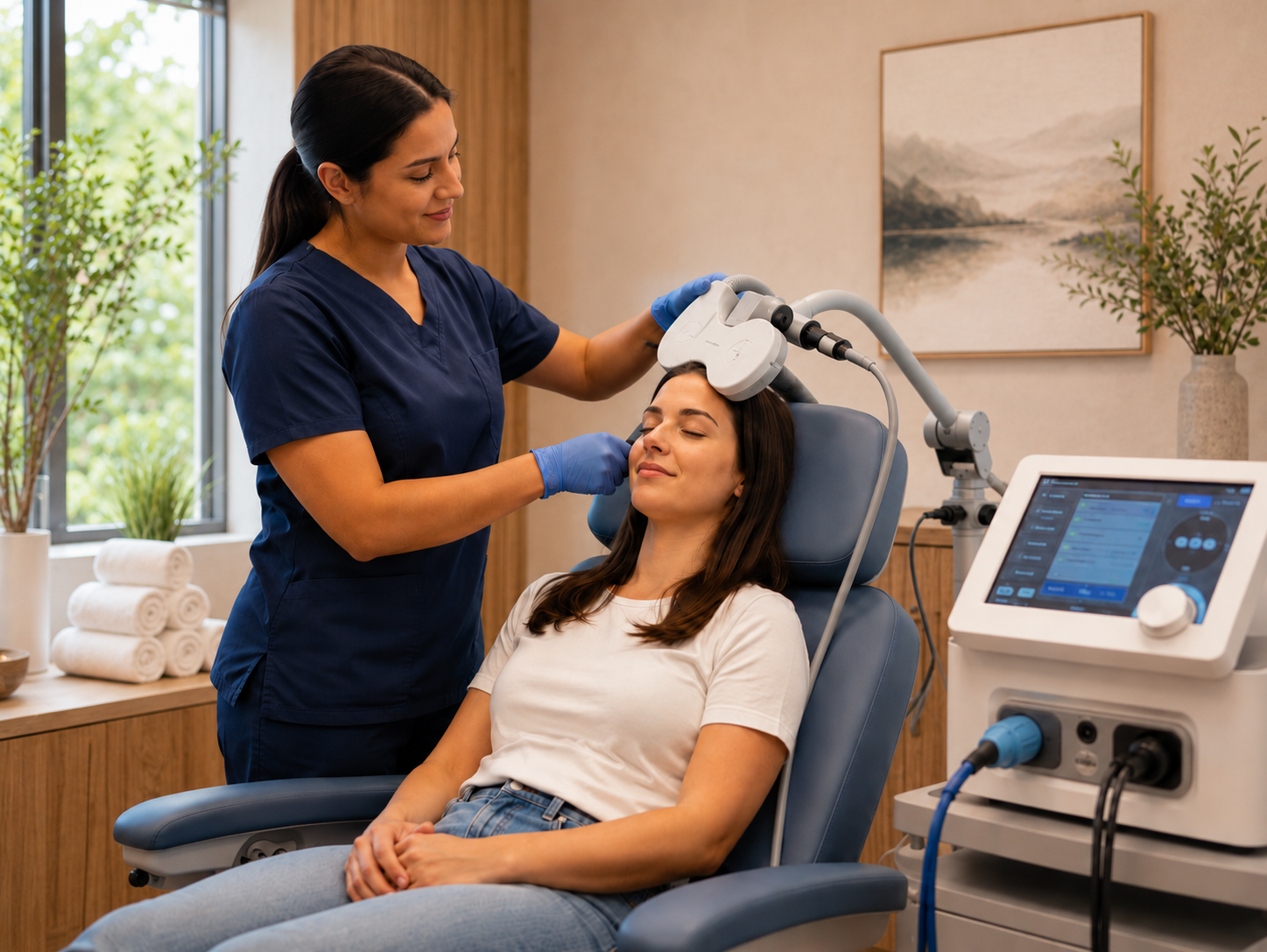
TMS stands for transcranial magnetic stimulation. It uses focused magnetic pulses, the same kind of field used in an MRI, to gently re-activate the mood circuits that go quiet in depression. It is done right in our office, and you stay awake and alert the whole time.
Three simple parts, repeated over a series of short visits.
A coil rests lightly on your scalp and sends painless, targeted pulses.
The pulses stimulate the prefrontal cortex, the region that runs quiet in depression.
Short daily sessions over a few weeks help the mood circuits strengthen and hold.
Here is the honest picture from the research. TMS does not help everyone. But for people who have not found enough relief from medication, the odds are meaningfully better than trying yet another pill.
Reached remission with TMS versus switching to another medication, in a 2024 head-to-head trial of people who had already failed two or more antidepressants.
Remission range reported across studies, depending on how severe and long-standing the depression is.
A standard course is about six weeks of short visits. Then you are done, with no daily medication to remember.
Sources: Dalhuisen et al., American Journal of Psychiatry (2024); pooled rTMS meta-analyses; STAR*D (2006). Remission means symptoms drop into the well range, not just improve a little. Results vary with depression severity and history.
A medication that did not work does not predict how you will respond to TMS. A failed pill tells you that adjusting brain chemistry across your whole body was not enough. It does not tell you how your mood circuit responds when it is stimulated directly. That is why TMS often helps people who had given up on getting better.
Three established treatments for depression, side by side, so you know what sets TMS apart.
| TMS | Antidepressants | ECT | |
|---|---|---|---|
| How it works | Magnetic pulses re-activate the mood circuit | Adjusts brain chemistry through the whole body | A brief, controlled seizure under anesthesia |
| Medication | None | A daily pill | Used alongside medication |
| Anesthesia | None | None | Required every session |
| Common side effects | Light scalp tapping and a brief headache | Weight, sleep, sexual, and stomach effects | Short-term memory problems and confusion |
| Downtime | None; you drive yourself home | None | Recovery time after each session |
| Time commitment | About 20-minute visits over roughly six weeks | Weeks to find the right dose | Sessions in a hospital setting |
| FDA-cleared for depression | Yes | Yes | Yes |
TMS is often a good fit when medicine alone has not been enough, or when side effects make pills hard to tolerate.
You relax in a comfortable chair while the coil delivers gentle pulses. A session is short, there is no sedation, and there is no recovery time. When it ends, you head right back to your day.
Simple, predictable, and built around your day. Here is the whole path from start to finish.
We carefully locate your treatment spot and set a comfortable dose. This first visit takes a little longer than the rest.
About 20 minutes, five days a week. You sit back, listen to music or relax, then drive yourself right back to your day.
Many people notice sleep and energy steady first, often before mood shifts. Everyone is different, and that is normal.
Mood often lifts during this stretch. We track your progress with brief check-ins and adjust as needed.
A full course is about 36 sessions over six weeks. When it wraps, we plan any maintenance together so your progress holds.
TMS is newer than pills, so a lot of misunderstanding follows it around. Here is what is actually true.
Fact: There is no anesthesia, no seizure, and no memory loss. You stay fully awake and drive yourself home afterward.
Fact: Most people feel a light tapping on the scalp. Any tenderness usually eases within the first few sessions.
Fact: TMS is FDA-cleared and often considered after just one or two medications have not been enough, not only at the very end.
Fact: Many people stay well for months. If symptoms return, a few maintenance sessions are straightforward to schedule.
TMS is launching at our clinics soon. Join the waitlist and we will reach out the moment scheduling opens.
TMS will be offered at all three of our clinics. Join the waitlist to be matched with the location nearest you.

Flexible financing
We're a preferred provider with CareCredit and offer interest-deferred payment plans, so you can begin care now and spread the cost over time. Apply or see if you prequalify in just a few minutes.
Apply with CareCredit